
unpredictable changes. Traditional systems are not always able to react in real time, especially in response to demand fluctuations, logistics disruptions, etc. Manual planning and disconnected tools are still common in many organizations and hinder quick decision-making, and add more risk to operations.
The use of artificial intelligence is transforming the supply chain operation by informing supply chains with data and making automatic decisions. Rather than responding when issues arise, AI can be used to forecast problems, streamline processes, and enhance coordination along the entire supply chain. This change is assisting companies in addressing feasible issues, which directly affect performance and dependability.
Demand Uncertainty solution through Predictive Intelligence
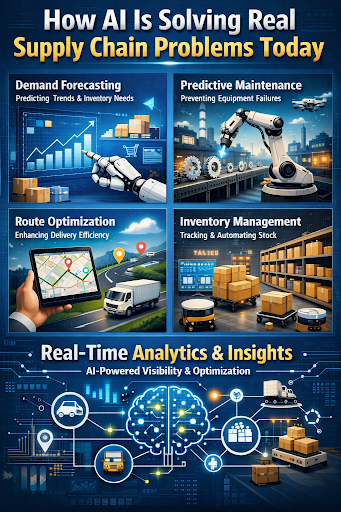
One of the most prevalent issues of supply chain management is demand uncertainty. Planning can be interfered with by sudden changes in customer behavior, seasonal trends, and external factors. The conventional forecasting techniques usually do not reflect these dynamic trends and may result in either overstocking or shortages.
The AI systems interpret historical data and real-time data of the market trends and customer activity. This enables companies to produce better demand projections and modify production or purchase plans as necessary. Predictive intelligence allows less waste to be generated and ensures that inventory is more in line with the real demand.
Lessening Inventory Disproportion and Waste
Balancing the appropriate amount of inventory is a continuous process. Too much inventory results in higher storage expenses and capital lock-up, and too little inventory causes a loss of sales and customer dissatisfaction. Conventional inventory management systems tend to be inflexible to adapt fast to the evolving conditions.
Intelligence-driven systems keep track of the stock, demand indicators, and supply chain status. They suggest the best restocking policies and distribution plans on the basis of real-time information. This will minimize the unnecessary stockpiling, and the products will be available whenever needed.
Enhancing Logistics and Delivery
There are various variables in logistics operations, which include transportation routes, delivery schedules, fuel costs, and external conditions. Handling these processes may result in inefficiencies and delays. AI can be used to streamline logistics by examining data within the whole transportation network.
The AI systems can find the most effective routes and dynamically change plans depending on traffic, weather, and delivery limitations. This enhances delivery time and minimizes the costs of operation. Effective management of logistics makes goods arrive at their destinations in a reliable and timely manner.
Improving Real-Time Visibility in Supply Chains
Lack of visibility is one of the main issues of most supply chains. Companies tend to struggle with tracking shipments, managing inventory, and quickly identifying disruptions. Decision-making is reactive and less effective without real-time insights.
Artificial intelligence-based platforms give a real-time overview of supply chain activity. They gather and interpret data on different platforms to provide one coherent impression of activities. The transparency enables businesses to identify problems at an early stage and make informed decisions to enhance the control of operations at large.
Repetitive and Complex Decisions
Supply chain management comes with many redundant activities and decision-making processes that must be attended to at all times. These processes are better handled manually, which exposes them to error and delays. AI also brings about automation, which enhances speed and accuracy.
Through AI Agent development, organizations can deploy intelligent systems that manage tasks such as order processing, inventory adjustments, and shipment scheduling. These agents operate continuously and adapt to changing conditions, ensuring that operations remain efficient without constant human intervention.
Strengthening Risk Management and Disruption Response
The supply chains are vulnerable to a number of risks, such as delays by suppliers, transport problems, and unforeseen market fluctuations. The early detection of such risks is very critical in ensuring continuity. The conventional systems tend to notice issues after they have already affected the operations.
AI systems examine the trends and detect any abnormalities that can cause possible disturbances. By providing early warnings, businesses can modify their strategies, reroute their shipments, or find alternative suppliers. Such a proactive attitude enhances resiliency and lessens the effects of unforeseen occurrences.
Empowering Strategic Planning
Supply chains’ strategic planning will need proper data and a clear understanding of performance measures. In the absence of faithful data, decisions tend to be made on assumptions as opposed to facts. AI assists organizations in shifting to information-based planning.
The data on the operations can be analyzed with the use of AI systems and provide insight into the trends of efficiency, cost, and performance. These insights help in long-term planning and help businesses in the areas of improvement. Strategies based on data contribute to more predictable and efficient supply chain operations.
AI and Existing Systems
A majority of organizations already have a mix of digital and old systems that they use to handle their supply chain activities. It is not always feasible to get rid of these systems completely. The AI solutions are made to work with the existing infrastructure so that functionality is added to it without causing any disturbance.
Through AI Supply Chain Software Development, businesses can build systems that connect data sources, automate workflows, and improve coordination. Integration ensures that AI capabilities enhance existing processes while maintaining stability and continuity across operations.
Improving Supplier and Partner Coordination
Supply chains require integration among various partners, such as suppliers, logistics, and distributors. Failure to communicate or a delay in information transfer may cause inefficiency and an inability to operate. Coordination is enhanced by AI by offering common insights and real-time information.
AI systems facilitate improved communication and sharing of data, which aligns the activities of all participants. This enhances coordination and ensures that every section of the supply chain is informed with correct and timely data.
Conclusion
AI is providing answers to real-world issues in the supply chain through predictive intelligence, automation, and real-time visibility of complex operations. AI allows businesses to work more effectively and swiftly to change depending on the ability to deal with demand uncertainty, deal with logistics, and enhance coordination.
The use of AI-based systems will gain importance as supply chains are also changing. By embracing intelligence in their solutions, organizations will be in a better position to manage complexity, minimize risk, and develop more resilient supply chain operations in an ever-changing global environment.
Read More: Maximum Time Off for Stress in the UK: What You Need to Know