
You wake up and reach for your computer. The device powers on, and you start working. But something feels different with the latest machines hitting the market. Technology has shifted under our feet while we were busy with our daily tasks. AI PCs have emerged as the next generation of computing power. These machines think and learn, and adapt in ways that sound impossible. Your old computer follows commands.
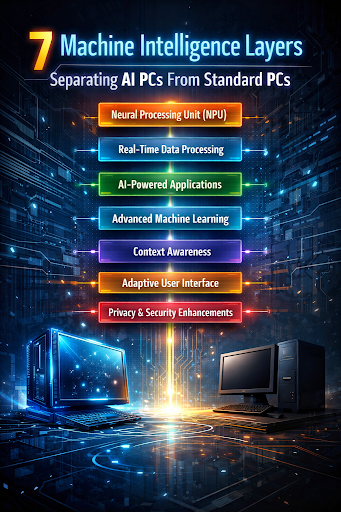
The new smart AI computer anticipates your needs before you speak to them. Seven distinct layers of intelligence separate these two types of machines. The gap between standard and AI-powered computers grows wider every single day.
1. The Neural Processing Unit Transforms Raw Computing Power
Standard computers rely on central processing units to handle every task. Graphics cards help with visual work. AI PCs bring something entirely new to the table.
The Neural Processing Unit that forms the basis of a smart AI computer changes everything about machine capability as it is a specialized chip dedicated to accelerating AI workloads locally without draining CPU or GPU resources. Traditional processors struggle under the weight of AI calculations. The NPU handles these complex tasks with ease.
Why Standard Chips Cannot Keep Up
Regular processors work like factory workers on an assembly line. They complete one job before moving to the next. AI workloads demand a completely different approach.
The NPU processes thousands of operations at the same time. Parallel architecture allows it to crunch billions of calculations every second. This design makes real-time AI features actually functional for everyday use.
The performance difference shows up in daily activities:
- Face recognition unlocks your device instantly.
- Voice commands respond without any delay.
- Video call background effects run smoothly.
- Battery life stays strong during intensive tasks.
With more people shifting towards these intelligent AI computers, their market is skyrocketing. As per a report, the global market of AI-enhanced PCs is expected to cross $2551.8 billion by 2035
2. Smart Memory Management Creates Personalized Performance
Memory allocation works fundamentally differently in intelligent machines. Standard computers follow basic rules when distributing RAM. AI PCs take a sophisticated approach based on your behavior.
The system observes which applications you open most frequently. It studies your daily routines and work patterns. This knowledge allows pre-loading of apps before you click anything.
- Programs launch almost instantaneously.
- Task switching feels seamless and smooth.
- Waiting time drops to nearly zero
- System responsiveness stays consistent
- Multitasking becomes effortless
The learning process runs continuously without your input. The more you use your smart AI computer, the better it understands your needs. This creates a computing experience that evolves alongside your work habits.
3. Real-Time Language Processing Eliminates Communication Barriers
Language capabilities take center stage in AI PC functionality. These machines understand and generate human communication naturally. Built-in language models run directly on your hardware.
You can translate documents between dozens of languages instantly. The AI captures context and meaning rather than simple word-for-word conversion. Nuance and tone get preserved in ways that basic translation tools miss completely.
- The system identifies individual voices accurately.
- It creates searchable text records automatically.
- You can find specific quotes using simple queries.
- Audio content becomes instantly accessible.
- No manual note-taking required.
The language capabilities extend into technical work. Developers describe their needs in plain English. The AI generates functional code in multiple programming languages. This bridges the gap between human thought and machine execution.
4. Visual Intelligence Understands What You See
Computer vision technology transforms how AI PCs process images and video. These systems analyze visual content with human-like comprehension. The machine recognizes objects within photographs automatically.
It identifies people and locations, and even emotional expressions in faces. This analysis happens instantly without sending data to external servers. Standard computers display images beautifully. AI PCs actually understand what those images contain.
The difference matters for practical applications:
- Photo organization becomes completely effortless
- You search using descriptions like “sunset at the beach”.
- No manual tagging or folder systems needed.
- The right images appear immediately.
- Your photo library organizes itself.
5. Predictive Performance Optimization Runs Continuously
AI PCs monitor their own performance constantly and make adjustments. This self-optimization happens behind the scenes without any user input. The system tracks which components experience stress during different activities.
It predicts when you need extra processing power. Resources get allocated before bottlenecks can slow your workflow. This proactive approach prevents problems rather than reacting to them.
Battery management reaches new levels of sophistication:
- The computer learns your charging habits.
- It understands your daily schedule patterns.
- Power consumption adjusts for critical hours.
- Battery life extends when you need it most.
- Energy waste drops significantly.
6. Contextual Security Adapts To Emerging Threats
Cybersecurity enters a new era with AI-powered protection. These machines do not follow security rules blindly. The AI learns what normal behavior looks like for each user.
It establishes baseline patterns for application usage and file access. Any deviation from established patterns triggers immediate investigation. Protection becomes personalized and context-aware.
Malware detection works through behavioral analysis rather than signature matching:
- The system recognizes malicious activity from brand-new threats.
- Traditional antivirus software cannot match this proactive protection.
- Zero-day exploits get caught before causing damage.
- Protection updates happen automatically.
- Your security improves without manual intervention.
If you talk about AI in the cybersecurity market, the numbers are rising. The global market share is expected to surpass $93.75 billion by 203,0, with AI PCs being mainly used to detect threats and attacks.
7. Adaptive Interface Design Matches Your Working Style
The user interface evolves to match your actual workflow. AI PCs refuse to force you into predetermined design patterns. The system observes how you interact with menus and toolbars.
It identifies features you use frequently and ones you never touch. Interface elements reorganize themselves automatically. Important tools move within easy reach while unused options fade into the background.
Color schemes and text sizes adjust based on ambient lighting:
- Changes happen automatically throughout the day.
- Your eyes experience less strain during long sessions.
- Brightness adapts to surrounding conditions.
- Contrast optimizes for current lighting.
- Reading becomes more comfortable.
This adaptive approach extends to accessibility features. Users with different abilities get interfaces that work best for them. Customization happens automatically without complex setup procedures.
Conclusion
AI PCs represent a fundamental shift in computing technology. These seven layers of machine intelligence create experiences that seemed impossible just years ago. Each layer builds on the others to create something truly remarkable. Standard PCs will serve basic needs for years ahead. But a smart AI computer unlocks possibilities we are only beginning to discover. Your choice between these technologies shapes not just what your computer does today but what you accomplish in your future.
Read More : How to Apply for the UK May Intake: Guide for International Students